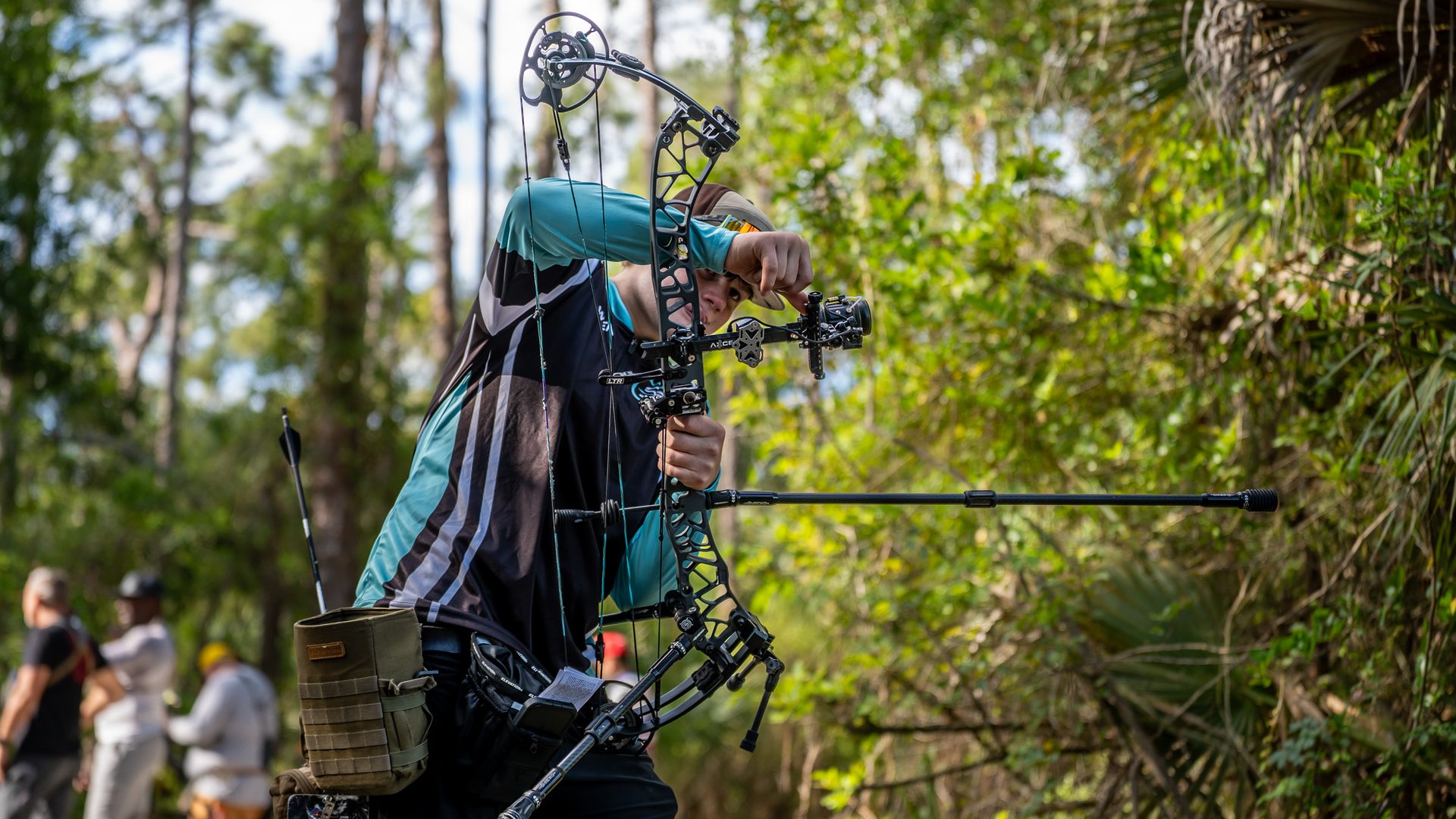
Most compound bows leave the factory close, not finished. The cams are timed within a tolerance the manufacturer is comfortable with. The rest is set near center. The peep is roughly where the average archer's anchor lands. Close is fine for the showroom. Close is not fine when you are trying to drive a broadhead into a kill zone at 50 yards or shoot a 12-ring at an ASA shoot. The gap between close and tuned is exactly what this page is about.
I am Robert Gilbert, USA Archery Level 3 NTS certified, an Elite Archery dealer, and the owner of Archery Sarasota. I run a two-acre private facility with a 120-yard outdoor range, and tuning is one of the services we do most often. What follows is the framework we use to tune any compound bow, the pricing, the symptoms that tell you your bow needs work, and how to get a bow to us if you are not local to Sarasota.
When You Need a Tune
Most archers wait too long. The signs are usually there for weeks before the groups fall apart, and a tune that takes 90 minutes in the off-season turns into a frustrating week of guessing the day before a hunt. Five symptoms come up over and over.
1. Broadheads not grouping with field points
You sight in with field points all summer. Two weeks before the season you screw on the broadheads and watch the arrows print three to six inches off the field-point group. That is a tuning problem, not a sight problem. Broadheads exaggerate any flaw the field point hides because the blades catch air the moment the arrow leaves the rest. The fix is rest position, cam lean, or arrow spine, and you cannot guess your way to which one. We chronograph every setup before and after tuning, so the speed change tells us the tune is real, not just a feel. More on this in our broadheads and field points guide.
2. Arrow tail high or low at impact
Shoot through paper at six feet and you will see a tear. A clean bullet hole is what you want. A tail-high tear means the nock end is kicking up off the rest, usually a rest that needs to come up or a cam that is rolling over early. Tail-low is the opposite. Tail-left or tail-right on a right-handed shooter is usually centerline. Paper does not lie. If the tear is the same shape every time, the bow is telling you exactly what is wrong.
3. Bow feels louder or has new vibration
A tuned bow is quiet. New buzz at the shot, a louder thunk, or a hand-shock you did not feel a month ago all point to something that has shifted. Often it is a limb bolt that backed off a quarter turn. Sometimes it is a string stretch that pulled the cams out of timing. Sometimes a peep rotation worth half a degree is enough to change the release feel. None of these are catastrophic on their own, and all of them compound into worse groups within a couple of weeks.
4. Sight tape was set up over a year ago and never reverified
Bowstrings stretch. Cams creep. Arrows change weight when you swap inserts, vanes, or points. A sight tape that was dead on at 50 yards a year ago is rarely dead on today. We see archers chase windage all season because the tape underneath is wrong, and no amount of sight tower work fixes a tape that no longer matches the bow's actual speed.
5. New string installed and groups shifted
Any string change resets the tune. Even a like-for-like replacement will settle in over the first 200 shots and pull the cams out of timing slightly. If you put a new string on and your groups opened up, that is normal. A retune at the 200-shot mark locks it back in. Our custom bow strings get tuned at install, but any string from any builder needs the same after-care.
The 6 Tuning Steps Explained
Tuning is not one step. It is a sequence, and the order matters because each step builds on the one before it. Skip cam timing and your paper tune will never settle. Skip paper and your walk-back will lie to you. Here is the order we run, every time.
1. Paper tuning
Paper is the first read on what the bow is doing. We hang a sheet of newsprint four to six feet in front of the target, with the shooter another six feet behind that. The goal is a clean round bullet hole, point and fletch through the same opening. A tail-high tear means the nock point is too low or the rest is too low. Tail-low means the opposite. A right tear on a right-handed shooter usually means the rest needs to move left a thirty-second of an inch at a time. Paper does not tell you the cause every time, but it tells you the symptom and gets you 70 percent of the way to a tune in 15 minutes.
2. Bare shaft tuning
A bare shaft is an arrow with no fletching. Shoot it alongside a fletched arrow at 20 yards, then 30, then 40. The fletched arrow steers itself back to the line of force. The bare shaft does not, so it tells you the truth about what the bow is doing at release. If the bare shaft prints low and left of the fletched group at 30 yards, you have a stiff arrow or a rest that is off. If it prints high and right, you have a weak shaft or a centerline issue. Bare shaft at distance is the most ruthless tuning step we run, and it is the one most home tuners skip.
3. Walk-back tuning
Set a vertical line of tape on the target. Shoot at the top dot from 20 yards, then 30, then 40, then 50, aiming at the same top dot every time. The arrows will fall down the page in a vertical column. If the column drifts left or right as you back up, your rest is not centered to the cam track. Move the rest a sixty-fourth at a time and shoot again until the column is dead vertical. Walk-back is what catches the centerline errors that paper missed.
4. Broadhead tuning
Once paper, bare shaft, and walk-back all read clean, broadheads should hit with field points of the same total weight. If they do not, the broadhead is exaggerating a flaw the others hid. Common fixes at this stage are a tiny rest move, a yoke tuning adjustment on cams that have a yoke, or an arrow spine change. We tune broadheads at 40 and 50 yards because the blades amplify any error at distance, and a hunter who can put broadheads in a fist at 50 can put them anywhere they need to under 50.
5. Cam timing
Cams should reach full draw at the same moment. On a dual-cam bow, that means the timing marks on the top and bottom cams hit the cable at the same instant the archer reaches the wall. If they do not, the bow is firing one cam ahead of the other and the arrow leaves with an uneven push. You feel desync as a soft wall, a creepy back-bar, or a release that does not feel crisp. We check timing with a draw board, not by eye, because half a degree is invisible to a shooter and devastating to a group at 60 yards.
6. Peep alignment and rest verification
The small stuff that adds 20 percent to consistency. Peep should sit square to your eye at full anchor, not requiring head tilt or a head turn to find center. Rest blade or launcher should be square to the riser and at the correct vertical relationship to the arrow nock. We finish every tune by re-checking both and locking the peep with serving so it cannot rotate. The bow that leaves the bench should be the same bow you draw next week.
What a Level 3 Coach Does That a Big-Box Store Won't
Big-box shops can tune a bow. They have paper, they have a press, they have a tech who has done it a thousand times. What they usually do not have is the time or the diagnostic instinct to ask the next question after the symptom goes away. Three things separate a Level 3 tune from a counter-service tune.
The first is diagnosing root cause instead of just symptoms. A clerk sees a tail-high tear, raises the rest, gets a clean tear, hands the bow back. A coach sees the same tear and asks why. If the paper tear comes back clean but groups still drift right at 50 yards, the rest move was a band-aid, not a fix. The real problem is often cam lean or a yoke that needs balancing. Same symptom, different root, very different long-term result. A bow that was patched will drift again in 200 shots. A bow that was diagnosed stays tuned.
The second is verifying with instruments instead of feel. We chronograph every tune with a Labradar Doppler radar, which reads arrow speed at multiple points down the flight path instead of guessing at the muzzle. If a tune adds two feet per second of speed, the tune was real. If speed dropped, something is wrong even if the paper looks clean. We also use a spin tester on every arrow build to catch a bent insert or a wobble that no paper test will show. See our Labradar guide for what the numbers actually mean.
The third is matching the tune to the archer's intent. A target archer and a hunter need different tunes from the same bow. Target tunes prioritize consistency across one or two known distances and tend to accept a slightly slower setup in exchange for forgiveness. Hunting tunes prioritize broadhead flight, speed for pin gaps under pressure, and quiet at full draw. A clerk tunes for paper. A coach tunes for the archer.
Most bow shops will get you 80 percent of the way. The last 20 percent is where target archers find the X ring and hunters find the kill zone at 50 yards. That is the gap we close.
Tuning Pricing and What's Included
Pricing is flat and posted. Pay at the bench when the work is done. We do not take deposits and we do not bolt on parts you did not ask for.
Standard tune. $100 per hour. Most tunes finish in 1 to 1.5 hours. Includes paper tuning to a clean bullet hole, walk-back tuning out to 50 yards, peep alignment and lock-in, and a final group check at your primary distance. This is the right tune for target archers, 3D shooters, and anyone whose bow is otherwise healthy and just needs a verification pass.
Full hunting tune. $150 flat. Includes everything in the standard tune plus broadhead verification with your actual hunting heads at 40 and 50 yards, Labradar chronograph readings before and after to confirm the tune added or held speed, and sight tape verification at the distances you hunt. Bring six broadheads minimum and field points of identical total weight. This is the tune to book if you are pulling for a deer, hog, or western elk hunt and want the bow verified end to end.
Cam timing with new strings. $200 flat. Parts extra. Includes cam timing on a draw board, full press service, new string and cable install, post-install break-in shots, and a full standard tune once the string has settled. If your strings are over two years old in Florida or you have visible wear, this is the service to book. Custom string and cable parts are quoted at booking based on bow model. Read more about our custom strings.
Mail-in service. Florida only. $150 flat including return shipping. Includes a standard tune by mail, a video call to walk you through the results before we ship the bow back, and a UPS or FedEx return label paid by us. Hunting tune by mail is $200 flat including return shipping if you want broadhead verification, but we will need you to ship your broadheads with the bow.
Pay at the bench when the work is done. No deposits, no upsells, no surprises.
How to Ship In or Drop Off
Two ways to get a bow tuned at Archery Sarasota. Drop-off if you are local, mail-in if you are not.
Drop-off in Sarasota
Book online at the booking page or call (941) 322-7146 to set up a time. We are at 5519 Cynthia Ln in Sarasota, on a two-acre private facility with covered indoor lanes and a 120-yard outdoor range. Most tunes are done while you wait, in 1 to 1.5 hours. Bring the arrows you actually shoot, your release aid, your sight tape if you have one printed, and your broadheads if you booked a hunting tune. Coffee is on in the shop. If the weather is good, the outdoor range is open after we finish so you can test groups at distance before you drive home. We pull a lot of repeat customers from Bradenton, Lakewood Ranch, and Venice, plus drive-ins from Tampa, Orlando, and Fort Myers.
Mail-in from anywhere in Florida
Five-step process and you do not need to leave home.
- Call (941) 322-7146 or email through the contact page to talk through which tune you need and confirm your bow and arrow setup.
- We email you a prepaid UPS or FedEx shipping label sized for a bow case or hard case.
- Pack the bow with the limb bolts backed off two turns, no arrows in the box, your release if you want us to verify draw length, and any broadheads if you booked a hunting tune. Tape the box, stick the label on it, and drop it at any UPS or FedEx counter.
- We receive the bow within 1 to 2 business days, get it on the bench inside 24 hours of arrival, tune it, then video-call you to walk through the paper tears, the Labradar readings, and the broadhead group photos before we ship it back.
- Total turnaround is typically 5 to 7 days from your ship date to the bow back on your porch.
Mail-in is the right call if you are in Miami, Jacksonville, Tallahassee, the Panhandle, or anywhere far enough from Sarasota that a same-day drive is a chore. You get the same tune as our walk-in customers, on the same Labradar, by the same coach.
Florida-Specific Tuning Notes
Florida tuning is not the same as tuning in Colorado or Pennsylvania. Two things drive the difference. Humidity and temperature swings.
Bowstrings shrink and stretch with seasonal humidity. A string built in February dry-season air at 60 degrees Fahrenheit will read differently in August at 90 degrees and 80 percent humidity. We see real cam-timing creep across the spring-to-summer transition every year. A bow that was dead-on tuned in March is often 5 to 8 feet per second off and a quarter turn of cam timing late by July. That is why we retune hunters before season opens, which in most of the state means late July for early archery openers, and why we retune 3D and ASA shooters before regional shoots in the spring and fall. Our Florida bowhunting readiness check walks through the full pre-season verification list.
The other Florida-specific factor is what archers actually shoot here. We are a hunting and 3D state more than an NFAA indoor or Olympic recurve state. Most tunes we run are 60 to 70 pound compound setups for whitetail, hog, and the occasional Osceola turkey hunt, plus 3D rigs that need to be accurate from 15 to 50 yards. Arrow builds reflect that. Heavier total weight, mid-weight broadheads, fletching tuned for arrow recovery at 30 to 50 yards. If you are tuning for that target audience, our custom arrow builds are spec'd to match.
Common Questions
The eight questions we get asked the most about bow tuning, drop-off, and mail-in service. Scan the section below if you have a specific question. If you do not see your question, call us at (941) 322-7146.