Labradar for Archery. Why It Matters.
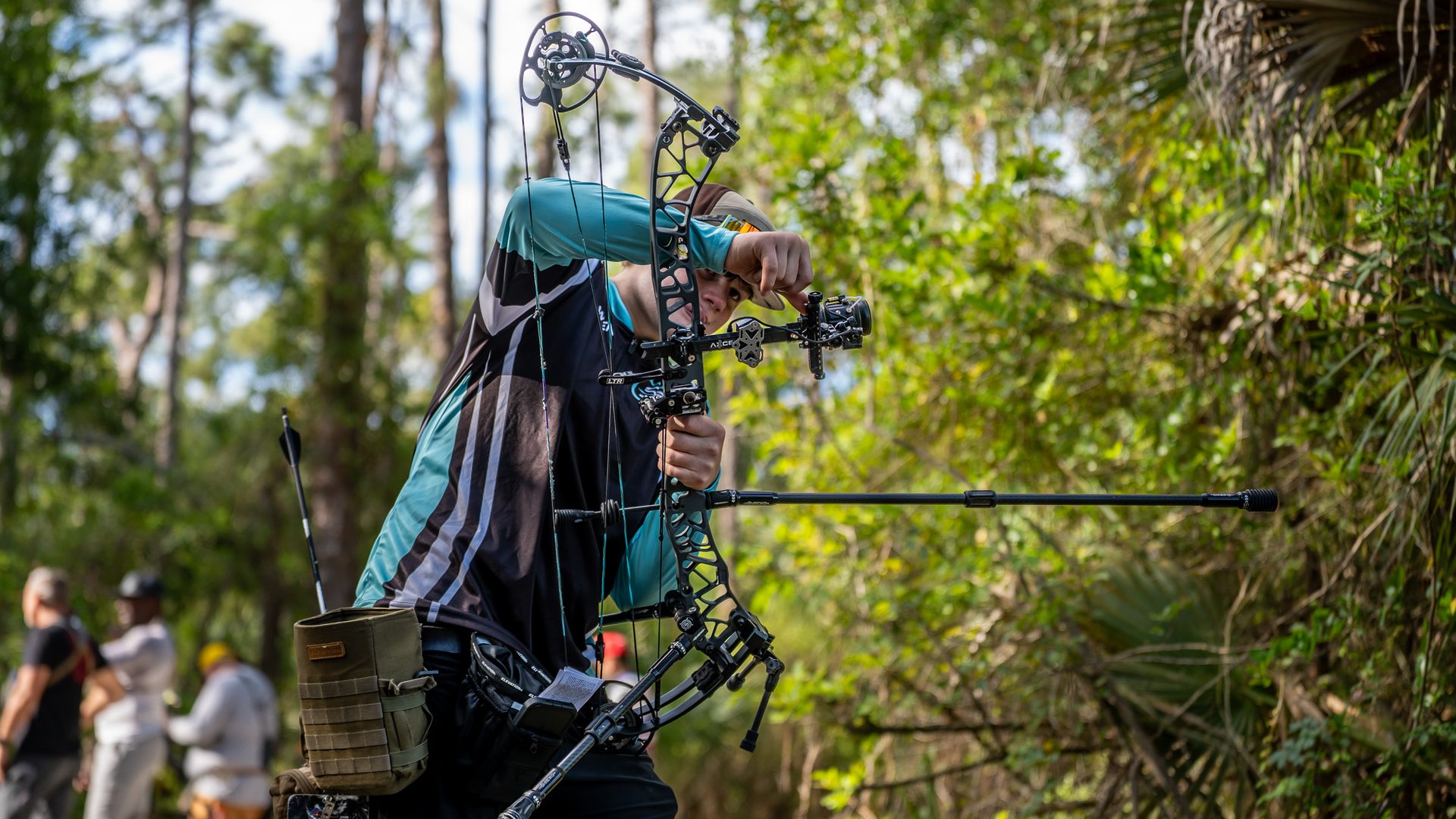
A chronograph that uses Doppler radar. Instead of optical sensors. Solves a problem that's existed in archery for decades: you couldn't actually verify your arrow's true velocity in real shooting conditions, with broadheads, at field-realistic distances.
The Labradar changed that. The original Labradar (still in widespread use) and the current Labradar LX (now part of Garmin's product line) both work the same way: continuous-wave Doppler radar reflections off the arrow as it flies, capturing velocity to ±0.1% accuracy at the muzzle and through downrange flight. We use the LX in our shop; the technique below applies to either model.
For archery, this enables three things that conventional chronographs and paper-tuning can't: accurate sight tapes built to your arrow's real velocity, broadhead flight verification at hunting distance, and tuning decisions backed by real numbers instead of guesses.
This guide explains what the Labradar measures, how we use it during a tune, and why it's a non-negotiable tool for serious bowhunters and competitors.
What Labradar Doppler Radar Actually Measures for Archery
A traditional optical chronograph (the kind with two screens you shoot through) measures the time it takes a projectile to break two beams a known distance apart. Easy in principle, but in archery it has problems:
- The "screens" have to be carefully positioned and oriented or you get false readings or no reading at all
- Lighting conditions affect optical accuracy
- You can only measure muzzle velocity. What happens at 30, 60, 100 yards is invisible
- Arrow vanes can disrupt the optical trigger
A Doppler radar chronograph works differently. It emits a continuous radio wave forward of the unit, then measures the frequency shift as the projectile flies through the beam. From the frequency shift, it computes velocity. Multiple times per second, at multiple downrange distances.
For an arrow, the Labradar typically reports:
- Muzzle velocity (V0)
- Velocity at 10, 20, 30 yards (and beyond, with the right setup)
- Average / high / low / extreme spread / standard deviation across a shot string
- Energy (calculated from velocity and arrow mass)
That last one matters for hunters. Kinetic energy at the shot, not at the bow, is what penetrates.
Why Doppler Matters for Archery (More Than for Rifles)
For rifle shooters, optical chronographs are usually fine. Bullets fly fast enough and consistently enough that even rough velocity numbers translate cleanly to ballistic tables.
Archery is different. Here's why Doppler is a step-change:
1. Arrow velocity drops fast. A typical hunting arrow leaves the bow at 280–290 fps. By 80 yards it's slowed to 200–220 fps. That deceleration curve matters for sight-tape accuracy past 60 yards, and you can't measure it with an optical chronograph. 2. Sight tapes are built from velocity. Every modern compound sight uses a sight tape, a vertical strip with yardage marks calculated from your arrow's velocity, weight, peep height, and draw length. Get the velocity wrong by even 5 fps and your 80-yard mark is off by 1.5 inches. We build sight tapes through Precision Cut Archery using Labradar-verified velocity numbers. 3. Broadhead drag changes everything. A field point and a fixed-blade broadhead leave the bow at near-identical velocities. But a fixed-blade broadhead loses velocity faster downrange because of drag. Doppler radar captures the difference. Optical chronographs only capture muzzle velocity. They can't tell you why your broadheads aren't grouping with your field points at 50 yards. 4. You can verify shot-to-shot consistency. Standard deviation across a 5-arrow string tells you whether your bow is delivering consistent velocity (it should be, if it isn't, your release, anchor, or tune is off).How Archery Sarasota Uses Labradar in a Florida Bow Tune (2026)
A typical Labradar-verified tune session at our facility runs through this sequence:
1. Baseline shot string. 5–8 arrows with field points at the bow's current setup. We capture muzzle velocity, downrange velocity, and standard deviation. This is the baseline. 2. Tuning iterations. Each adjustment. Cam timing, draw weight, draw length, rest position, arrow spine. Gets verified with another shot string. We can see in real time whether a change improved velocity consistency or made it worse. 3. Sight tape build. Once the bow is tuned, we record final muzzle velocity and downrange velocity at 30 and 60 yards. These numbers go to Precision Cut Archery, who cut a sight tape calibrated to YOUR bow. 4. Broadhead verification. Switch to broadheads, repeat the velocity capture at 30, 60, 80 yards. If broadhead velocity diverges from field-point velocity beyond expected drag, we know broadhead flight is off, and we tune accordingly. 5. Pre-hunt verification (for hunters). Final shot string with hunting arrow, hunting broadhead, hunting setup. Documented velocity numbers in case you need to rebuild the bow next year.What This Unlocks That Optical Chronographs Don't
For competitive shooters:
- Sight-tape accuracy past 60 yards (where optical-chrono-built tapes start drifting)
- Verified consistency before tournaments
- Ability to spot a tuning issue from velocity standard deviation before it becomes a scoring issue
For Western bowhunters:
- Real flight numbers at 80, 100+ yards where elk and mule deer shots happen
- Confidence that your sight is calibrated to actual arrow flight, not interpolated guesses
- Pre-hunt baseline you can verify against post-hunt to catch any setup drift
For TAC competitors:
- Long-range velocity data critical for unknown-distance courses
- Confidence the rangefinder + sight tape combination is dialed
- See TAC setup for the complete workflow
For local bowhunters:
- Broadhead flight verification at real hunting distance
- Diagnostics on why your broadheads aren't matching field points. See broadheads-field-points-dont-match
Labradar LX Cost in 2026. Can You Buy One Yourself?
Yes, the Labradar LX retails around $600. Garmin sells it through major archery retailers. It's a great purchase for serious DIY tuners.
The catch is two-fold:
1. Setup matters. A Labradar mis-positioned reads inconsistently. The acoustic trigger has to face the bow correctly, the radar has to see clean line of flight, and ambient acoustic noise can corrupt readings. There's a learning curve.
2. Reading the data is its own skill. Knowing that your standard deviation is 4.2 fps is one thing. Knowing whether that's good, bad, or symptomatic of a specific tuning issue takes coaching context.
For most archers, having a coach run the Labradar for tuning sessions is more efficient than buying one and learning to interpret it yourself.
What We Don't Use Labradar For
To be clear, Doppler radar is a tuning and verification tool. Not a magic bow improver. It doesn't:
- Tune your bow for you
- Replace good shooting form
- Replace paper tuning, walk-back tuning, or bare-shaft tuning (all of which we still do)
- Replace broadhead spin testing or arrow spotter checks
It's the verification layer ON TOP of the standard tuning workflow. Without good fundamentals, accurate velocity numbers don't help.
If you want your bow tuned and verified with Labradar Doppler radar, the same tool used by U.S. national-team coaches and elite Western bowhunters, that's our standard process. Book a bow tuning session or contact us to talk through your setup.
“A chronograph reads velocity at the bow. Labradar reads velocity at multiple downrange points. That's not the same data. Sight tapes cut from manufacturer ballistic estimates are wrong by 1–4 inches at 60 yards for the average archer's setup. Labradar-verified sight tapes are wrong by 0.1–0.3 inches.”
— Rob Gilbert, USA Archery Level 3 Coach, Archery Sarasota
Labradar & Archery. FAQ
What does Labradar Doppler radar actually do for archery?
Labradar uses Doppler radar to measure your arrow's velocity at the bow, at distance, and at user-set intervals along its flight path. For archery, that means you can see real arrow speed (not the bow's IBO sticker speed), kinetic energy at the target, and how much your arrow is slowing down per yard. Combined with shot-by-shot consistency data, it shows you tune problems that group size at 20 yards will never reveal.
Why is Labradar more useful than a paper chronograph for archers?
Optical chronographs only measure muzzle (or near-bow) velocity. Labradar tracks the arrow's full flight, so you can see velocity drop, identify inconsistent arrows in a set, and verify whether your broadhead-tipped arrow flies the same as your field point at distance. For tournament archers, Western bowhunters, and TAC shooters, that downrange data is the difference between guessing and knowing.
Is Labradar worth it for the average bowhunter?
For most Florida whitetail and hog hunters shooting under 30 yards, no, the precision Labradar offers exceeds the precision the shot situation needs. Where Labradar earns its keep is Western elk and mule deer hunts where 50-80-yard shots are realistic, TAC distance courses where 100+ yards is the norm, competitive ASA and USA Archery target shooting, and any time broadheads aren't grouping with field points and you need to find out why.
Can I use Labradar at home or do I need a range that has one?
You can buy a Labradar unit and use it at any range or backyard setup that has enough distance behind the target. They retail around $560-$700 for the LX, with the older base model lower. The catch is that a meaningful Labradar session needs distance to actually run the test (40+ yards minimum for arrow drop data, ideally 80+ for hunting verification, 120+ for tournament work). If you don't have that distance available, booking a session at a range that does makes more sense than buying.
What can I learn from a single Labradar session at Archery Sarasota?
In a single 60-90 minute session you can verify your real arrow speed, confirm broadheads fly with field points, identify any inconsistent arrows in your set, lock in true sight tape numbers from 20 to 80+ yards, and document kinetic energy at the distance you actually shoot. For bowhunters preparing for a Western trip or archers preparing for an outdoor national tournament, that one session typically resolves more questions than a season of guessing at the indoor range.
Does Labradar work indoors?
Technically yes for short distances, but the value of Labradar for archery is in tracking the arrow over real distance, and indoor lanes (typically 20 yards) are too short for the data to be meaningful. Labradar shines on an outdoor range where you can see velocity drop, broadhead behavior, and consistency at 40, 60, 80, and 100+ yards.
Have a Question About Your Setup?
If you're a Florida archer trying to put what you read here into practice. Book a session.
Book a Session